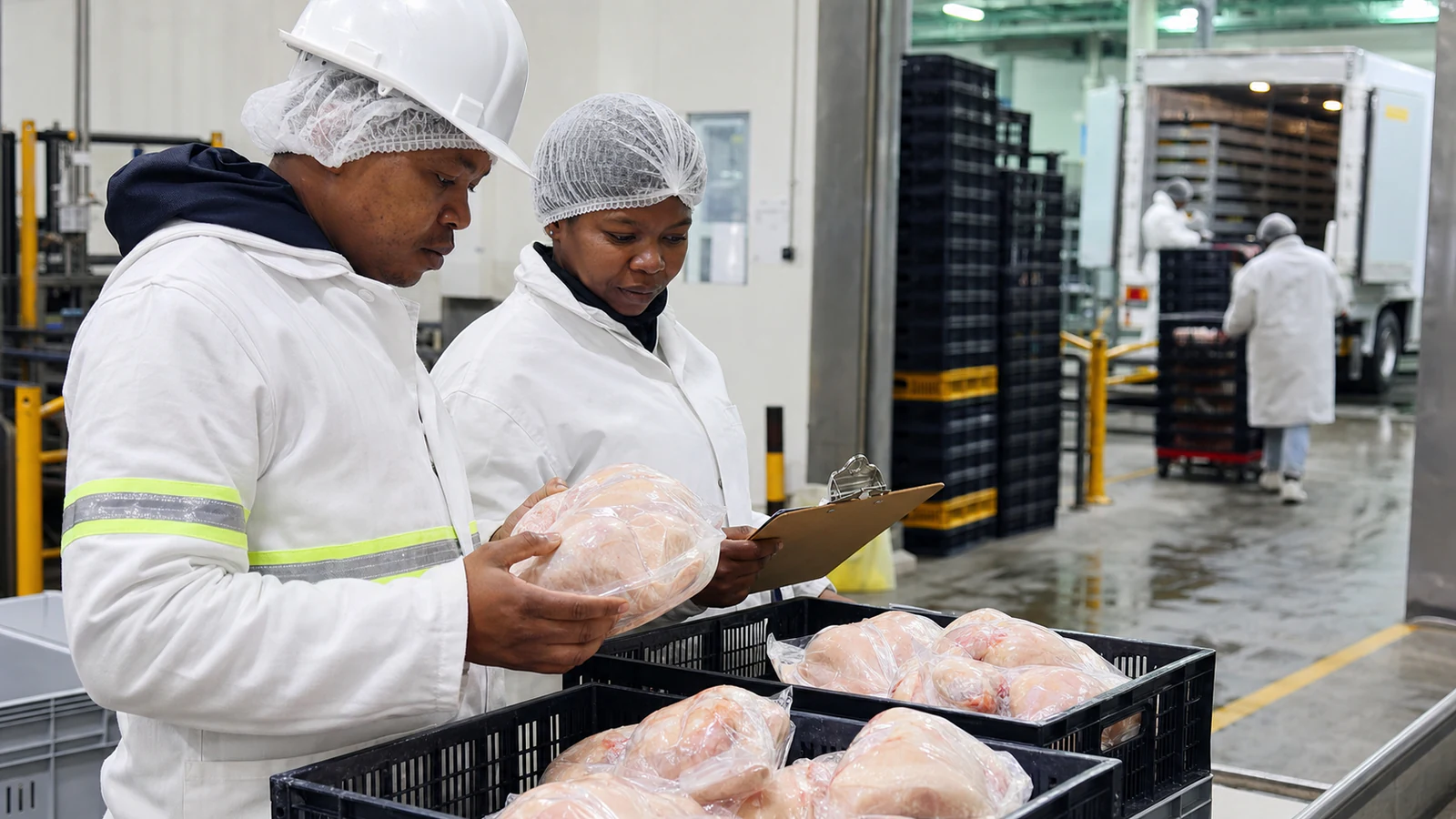
Rainbow Chicken’s latest financial performance has placed renewed attention on the economics of one of South Africa’s most strategically important food industries, as poultry producers navigate the competing demands of affordability, operating efficiency and long-term investment.
Chicken occupies a distinctive position in South Africa’s consumer economy. It is one of the country’s most widely consumed sources of animal protein, making changes in production costs and retail pricing particularly relevant to household budgets.
For producers such as Rainbow, that creates an unusually tight commercial balancing act.
Businesses need to recover rising feed, electricity, transport, labour and processing costs while operating in a market where consumers remain intensely price sensitive.
Rainbow’s latest results therefore provide a useful barometer of conditions across both food manufacturing and the broader consumer economy.
The poultry value chain is highly exposed to agricultural input costs. Feed represents one of the largest expenses in chicken production, linking producer margins directly to the price of maize, soya and other agricultural commodities.
Changes in grain markets can consequently alter poultry economics rapidly.
At the same time, producers must manage biological risks, processing efficiency, distribution networks and cold-chain requirements while competing against domestic rivals and imported products.
South Africa’s electricity environment has added another layer of complexity.
Large food-processing operations require reliable power for production, refrigeration and storage. Although the national electricity supply picture has improved from the worst periods of load shedding, producers have spent significant capital on resilience and alternative power systems.
That investment protects production but raises the capital intensity of operating in South Africa.
The latest Rainbow numbers should consequently be viewed in the context of an industry that has had to become more efficient while simultaneously strengthening its operational resilience.
For investors, margins are central.
Food businesses can generate substantial revenue while still experiencing pressure on profitability when input inflation cannot immediately be passed through to consumers.
The ability to improve processing yields, procurement, product mix and logistics therefore becomes particularly important.
Scale can help.
Large integrated poultry producers have greater opportunities to optimise feed procurement, farming, processing and distribution across the value chain. But scale also creates significant fixed costs and requires plants to maintain high utilisation levels.
The consumer environment remains a crucial constraint.
South African households have faced years of pressure from elevated living costs, high borrowing expenses and weak economic growth. Even where headline inflation moderates, consumers do not automatically regain the purchasing power lost during earlier price increases.
That means food producers cannot assume that every cost increase can be passed through.
Poultry is particularly sensitive because its relative affordability is a major part of its appeal.
If chicken prices rise too rapidly, consumers can trade down between product categories, reduce volumes or shift purchasing patterns. Producers therefore need to protect affordability while maintaining economically sustainable operations.
The industry also remains important from a national food-security perspective.
South Africa has sought to strengthen domestic poultry production and investment while balancing the role of imports and competition. The sector supports farmers, feed producers, processors, logistics companies and retailers, creating a substantial domestic supply chain.
Investment decisions by large producers consequently have implications beyond listed-company earnings.
Modern processing facilities require capital, while biosecurity has become increasingly important following outbreaks of avian influenza in recent years. Maintaining sufficient domestic capacity can reduce vulnerability to international supply disruptions, although local producers remain exposed to agricultural and disease risks.
The performance of businesses such as Rainbow therefore intersects with several national priorities: food affordability, industrial production, agricultural development and employment.
The results also offer insight into South Africa’s broader manufacturing challenge.
Food processing is one of the country’s largest manufacturing subsectors and benefits from consistent underlying demand. Yet producers face many of the same structural costs confronting other manufacturers, including logistics constraints, municipal infrastructure weaknesses and historically unreliable electricity.
Companies able to lift productivity despite those pressures can strengthen their competitive position, but continuous efficiency investment is required.
Rainbow’s future performance will depend partly on variables outside management’s direct control.
Feed prices, disease outbreaks, consumer demand and competitive pricing can all materially influence profitability. Currency movements can also affect imported inputs and equipment.
Operational execution, however, remains firmly within the company’s control.
Investors will therefore monitor whether improvements in plant efficiency and cost management can produce more resilient margins across different commodity and consumer cycles.
For the South African economy, the stakes are broader than the performance of a single listed company.
A financially sustainable domestic poultry sector is important because it combines agriculture, manufacturing and consumer demand in one value chain. It also supplies a product that forms a central component of millions of household food baskets.
Rainbow’s latest results underline the tension at the heart of that system.
Producers need sufficient returns to continue investing in farms, processing capacity, energy resilience and biosecurity. Consumers, meanwhile, need affordable protein in an economy where household finances remain constrained.
How successfully South Africa’s poultry industry manages that tension will influence not only shareholder returns, but also food security and domestic manufacturing investment.