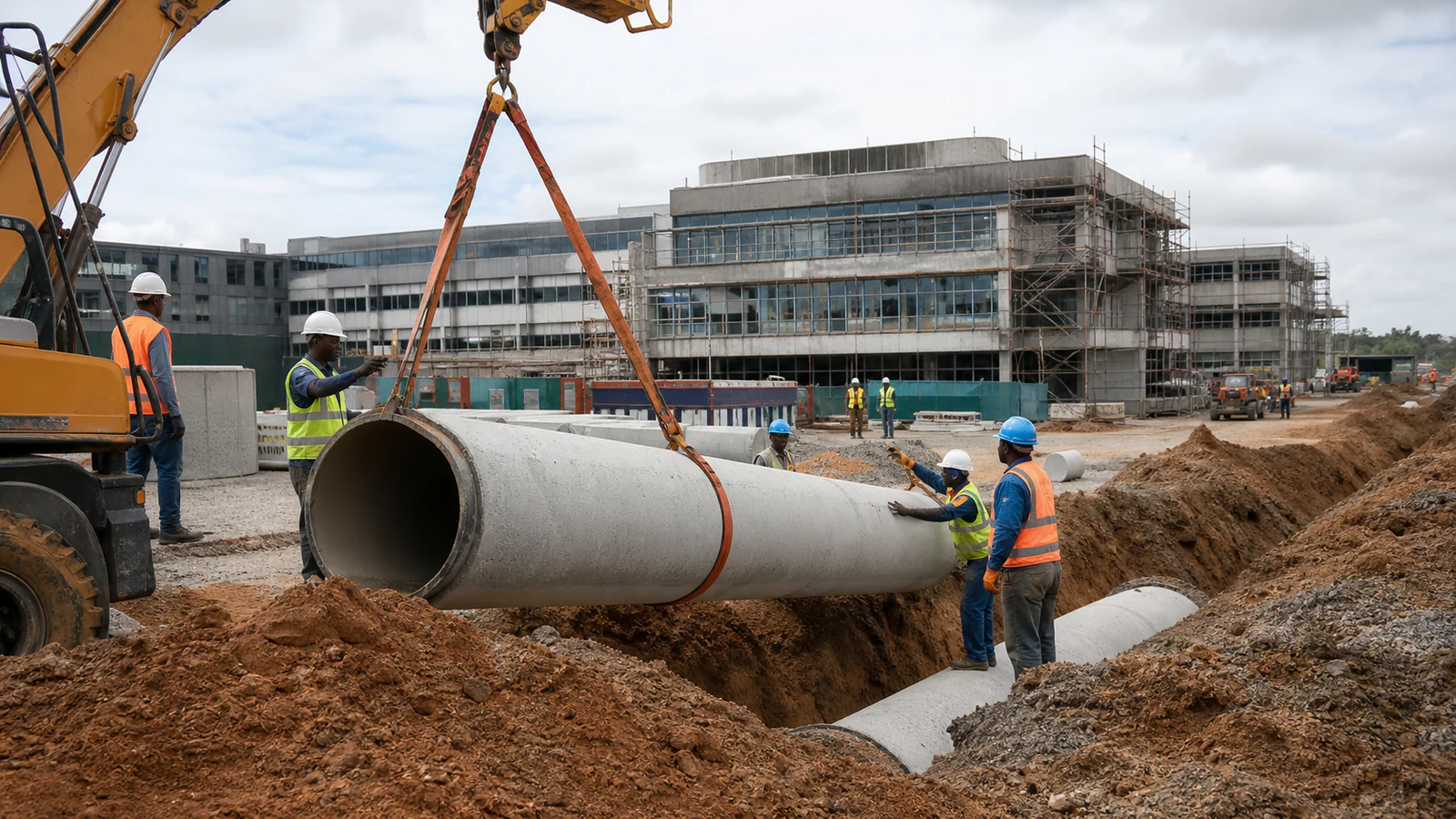
South Africa has signed two New Development Bank loan agreements worth a combined $405 million for healthcare and bulk-water infrastructure, adding fresh development finance to two areas where capacity constraints have direct economic consequences.
Two projects receive financing
The package includes $200 million for a planned 488-bed tertiary hospital in Limpopo and $205 million for the Magalies Bulk Water Supply Scheme.
The water project is intended to improve supply to municipalities in Limpopo and North West where demand has placed pressure on available infrastructure.
The financing is important because both projects represent funded capital programmes rather than infrastructure ambitions without committed finance.
Water is increasingly a business constraint
Reliable bulk water is essential for households, but it is equally important for industrial development, agriculture, mining, property construction and commercial investment.
Where municipal water systems lack capacity, new housing and industrial projects can be delayed even if electricity and transport connections are available.
Large bulk-water schemes therefore have economic effects that extend well beyond the utilities sector.
Healthcare creates a broad procurement chain
A 488-bed tertiary hospital represents a substantial construction and procurement programme. Beyond civil works, major hospital developments require electrical and mechanical systems, medical equipment, digital infrastructure, security, catering systems and long-term maintenance.
That creates opportunities for contractors, engineers, manufacturers, technology providers and professional-services firms.
Development finance broadens the funding pool
The New Development Bank was established by the original BRICS members to finance infrastructure and sustainable-development projects in emerging economies.
For South Africa, access to development-bank capital can complement domestic infrastructure budgets at a time when fiscal constraints limit the government’s ability to finance every project directly from tax revenue.
The economic benefit, however, ultimately depends on execution. Financing agreements must translate into procurement, construction and completed assets before they can relieve infrastructure constraints.
Execution becomes the next test
South Africa has repeatedly identified infrastructure investment as a route to higher economic growth, but project preparation, procurement delays and implementation capacity have often slowed delivery.
The next milestones for businesses will therefore be the release of procurement packages, construction schedules and implementation details.
Engineering firms, pipe suppliers, equipment manufacturers and contractors will be watching for opportunities created by the water project, while the hospital programme could support a separate ecosystem of construction and healthcare suppliers.
Why it matters
The $405 million package targets infrastructure with immediate social value and longer-term commercial significance. Better water security can unlock development, while additional tertiary healthcare capacity strengthens an essential public service and creates a significant capital project.
If delivered efficiently, the two investments can provide both short-term construction demand and longer-term improvements to the productive infrastructure available to communities and businesses.